How the UK was “all astonishment”

Statistics is the study of the collection, analysis, interpretation, presentation, and organization of data. Interpretation is the act of explaining, reframing, or otherwise showing your own understanding of something. Well that all sounds straight forward enough in our statistics-obscessed society and lord knows we’ve had enough of it in the UK over the last few weeks building up to election day. On May 7th the Nation trotted along to the polls.

Election race

So, after weeks of numbers, facts, hypotheses and interpretations, at 10pm on election night you could hear the collective gasps of an entire Nation that clearly, no surely not, it couldn’t be, the statistics had all been wrong! As Lizzie Bennett would have said, “I am all astonishment”, except I’m sure the Nation was not so polite in its living rooms. But how? Well that is easy. Humans are involved. Obviously. (Full video is well worth watching – https://www.youtube.com/watch?v=8X6udrxMvCQ, TomoNews US).

The Guardian predicted Conservatives and Labour on an equal footing. UK Polling Report and Electoral Calculus are also both licking their wounds and puzzling why everything was so inaccurate.

I’m not really an expert but spend a fair amount of time playing with data doing bits and pieces of research. A Radio 4 show today really intrigued me: ‘More or Less‘, that featured an election special. Listening to the pollsters – the people that publish the numerous and tedious polls about things – It got me thinking how the election was adulterated.

Problem number 1
Polls rely on sampling the population. They might grab a big bunch of people to question and then match responses to what they believe a ‘representative’ population to be. This is all based on previous experience, models and assumptions, and at this point, a tiny little bit of error can be introduced. Making big interpretations from small samples is always dangerous.

Problem number 2
Polls rely on asking people their intended actions. If you poll me now, I’d tell you when I visit the supermarket tomorrow I shall buy a packet of Haribo Tangfastic. But what it won’t predict that when I get there, if there is a 2 for 1 offer on Fizzy Sea Monsters, I might just change my mind. So basing anything on people’s claimed views and opinions adds a little more error.

Problem number 3
System corruption. We see this in any system of measuring and I’ve written about this before with the National Student Survey. The more organisations relies on the outputs of surveys for for strategies and decision making, the more corrupt the process of gathering will be. We see this in education and healthcare all the time. I haven’t quite thought through the polling business yet, but this might have come into play.

Problem number 4
The pollsters interviewed on the Radio 4 show admitted that while interpreting and publishing data, they keep an eye on each other’s conclusions. I guess we do this in science a bit and nobody really wants to be a maverick with outlandish views – there is always pressure to be part of the set. So if we have a bunch of polling companies all seeing what each other is doing and tempering their observations accordingly, it is generally going to end as an inaccurate amorphous mash. I call this the ‘plasticine’ effect – we may start off with individual ideas and colours, but it is easier to follow the crowd and we ultimately end up a brown sludge colour.

Problem number 5
The media. Notorious for not every accurately portraying or communicating findings, this just adds an extra layer of sludge. The result – the entire Nation duped and not at all looking the right way. A bit like the famous video clip of the crowd at Nasa watching the Space Shuttle take off. They were looking the wrong way and the clip hilariously shows the shuttle taking off behind them!

Conclusion?
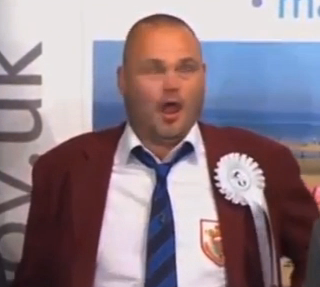
I would probably conclude that someone somewhere knew about this all along. The prize however for best ‘Election Night Look of All Astonishment’ does how ever go to Al Murray at the Thanet South count.

Al Astonishment

Bring on the summer!

Bucketnspade

Bring on the summer. A colleague and I have just finished interviewing for 3 student internship positions to work with us over the summer. We interviewed 7 students from 1st years through to graduates, and have been absolutely blown away by the talent and the entrepreneurship shown by our candidates. It’s left me thinking that their abilities and inherent skills stretch far beyond their undergraduate curricula. I’m questioning what are we doing at all to give young people the opportunity to explore, experiment and test their own abilities? University should be life changing after all?

Things that they are all doing?

Each without exception showed tremendous initiative and had looked for opportunities throughout their educational journey so far to be involved with projects. One candidate at the age of 15 had surveyed his school peers about the economic and financial plight of his home country. Another had helped enhance her family florist business. Another candidate exports second hand textbooks to schools oversees that are in need. Another has a long history working part-time in a fast food chain which is not for the faint-hearted surely, and spoke about seeing ‘through’ the job in order to collaborate and connect with his colleagues. These things were hidden and we had to tease them out which was interesting, and clearly not viewed as being immediately relevant. There is work to be done there clearly!

Personality traits they shared?

These are intuitive, opportunistic and dynamic people. They are willing to get stuck in and have a go. In fact, this project I think sounded quite dull from a scientist perspective – I really didn’t think it would attract anyone as it aims to explore public and patient involvement in education and research. I’m a bit nervous about having to move something in our department in a new direction. Our mantra is that all students just want to work in laboratories, but I have got this hugely wrong. The advert did attract a large number of students, and every one had a sense of adventure. It intrigues me that we just don’t see this in the classroom. Work to be done here clearly also.

So what are we doing to nurture this?

Where are our free spaces for students to develop their own ideas, initiative and intuition? We have undergraduate projects and activities built into university processes, but this immediately creates a barrier and starts constraining and clamping down on ideas. We need to open things up, but how? As we move along the road of ‘embedding employability into the curriculum’ and ‘embedding entrepreneurship’, in my 10 years experience of higher education I know enough to realise this is the nail in the coffin. We see this all over, once something becomes embedded, a target, a metric, it loses all effect, and time is spent obsessing over the process, and why we are 0.25% down on last year’s target.

However these internship schemes are a real success, as are international exchanges (e.g. #DMUglobal), opportunities to work in local communities (e.g. DMU Frontrunner), graduate futures awards (e.g. UWE Futures). I met a Graduate Associate from SOLENT University at OER15 who has been given ‘freedom’ to ‘go and do some stuff’ and came up with an astonishing open course to help introduce international students to university life before coming to the UK. These are all really good things.

If I ruled the world….

I would like to see education growing the individual and not just assessing the learning gained. There should be an ‘open module’ each year in which students can work on a campus based project; take time out to run a centre for student innovation; or take time out for a community or international initiative. And back to the original idea, shouldn’t we involve the public or relevant stakeholders in everything we teach?

Sorry this is an ‘off the top of my head’ article – I’m sure there are many more great initiatives out there I have missed. I can’t wait for the summer – not to sit on a beach or go and visit my friends Wendy and Mabel the donkeys at Western-Super-Mare, but to work with a group of amazing people.

Open education update – Bristol University presentation

Here's Fluffy

I’m very excited about talking to the Bristol University ‘pedagogy’ group about open education today. Here is a PDF of my slides:

SLIDES –> Open Education Update_VRolfe_5May15

The talk gave reference to a number of conference articles and papers, and the details of these are listed on my “talks and articles” page.

Links to the open education projects listed can be found under “open education“, including those I have participated in at Nottingham University and De Montfort.

Finally I made reference to the Open Education Conference (OER15) held in Cardiff this year. Videos of most of the presentations can be found via the conference web page. https://oer15.oerconf.org

Also I referred to Bronwyn Williams talking about ethics and the digital university at the SRHE event on 17th April 2015 (Methodology and Ethics for Researching the Digital University). You can find podcasts of Bronwyn’s talk which is absolutely a ‘must’ hear; just follow the links from this page. https://www.srhe.ac.uk/events/details.asp?eid=186